How to Play

Rules

Every rulebook in one place. Pick your game.

Step 1

Beginner Rules

New to Breakaway? Learn and play the Beginner Rules first — they teach you everything you need for your first games before you move on to the Advanced Rules below.

Goal: Score more goals than your opponent by playing cards to move the puck, shoot and score!

Setup

  1. Bench: Each player chooses 5 different Player cards (numbered 0-8 or Goalie) for their Bench. Don't worry about points for now.
  2. Deck: Use a deck of at least 60 cards. Make sure you have at least two of each Player card (0-8) and two Goalie cards. Shuffle your deck and place it face down. Create space for a Discard Pile next to it.
  3. Starting Hand: Draw 5 cards to start the game.
  4. Home Ice: Flip a coin or decide randomly who gets "Home Ice."

Gameplay

  1. Face-off:
    1. To start the game and after every goal, draw up to 5 cards, and then there's a Face-off at center ice.
    2. Both players may switch up to two cards with their bench.
    3. Both players choose one card from their hand and reveal it at the same time.
    4. The player who played the higher number wins the Face-off. The Home Ice player wins ties (in regular play, the defender wins ties, but this simplifies it for Easy Mode).
    5. The winner takes control of the puck at center ice (area 9) and plays their winning card onto the play area. The loser discards their card.
    6. The winner then takes the first turn.
  2. Taking Turns:
    1. Players take turns playing one card from their hand onto the previous card in the play area.
    2. After playing a card, use ONE Ability listed on that card (if any).

Abilities are any color listed on the card you played (if any).

     I. Every color moves the puck one adjacent area.
    1. After playing a card, use ONE Action listed on that card (if any). Focus on these basic Actions:
      1. Move: Move the puck one adjacent area while you control it.
      2. Shoot: Take a shot if you control the puck in the opponent's offensive zone (areas 1-6). The next card played by the opponent is the "Shot Card".
      3. Score: If the opponent just played a "Shot Card," play a card with the Score action to try and score a goal. (The Score and Goal card have this action).
      4. Save: If your opponent just played a "Score" action, play a card with the “Save” action to try and stop the goal. After every successful save action, the defender controls the puck.
      5. Bodycheck: Take control of the puck immediately where it is. (The Bodycheck card has this action).
    2. After playing your card and doing an action and/or Ability (if any), draw one card from your deck (unless your hand is already full - max 8 cards). Your turn ends.
  1. Doubles Rule:
    1. If you play a card that has the exact same number as the card directly beneath it in the play area (or is the exact same card if it has no number), you have played "Doubles"!
    2. When you play Doubles, instead of using the Action printed on your card, you may choose to perform any basic Action you want (Move, Shoot, Score, Save, or Bodycheck).
  2. Control: You "Control the Puck" if you were the last player to successfully Move it, win a Face-off, use Bodycheck, or save. Flip the puck token to your side. To control the puck means to have possession of the puck.

Scoring a Goal

  1. You must control the puck in the opponent's offensive zone (areas 1-6).
  2. Play a card with the Shoot action.
  3. Your opponent plays the next card (the "Shot Card").
  4. On your next turn, play a card with the Score action. If you cannot score, then you control the puck.
  5. Your opponent gets one chance to play a card with the Save action.
  6. If they cannot play a Save action, you score! Put the Shot Card and your Score card aside in a score pile. Reset for a Face-off at center ice. If they do play a Save action, the shot is stopped. Discard all the cards from the shot sequence. Play continues from the saving player's turn.

Winning

  • Play for a set amount of time or a set number of periods (e.g., one period). A period immediately ends when one player runs out of cards in their hand.
  • The player with the most goals wins

🏒 Comfortable with the basics? Scroll down to the full Official Rulebook and the searchable Specials Glossary.

Step 2 · Advanced Rules

The Official Rulebook

The complete Breakaway rulebook, section by section. Click any section to expand it.

Introduction

Welcome to Breakaway, the ice hockey simulation card game designed to capture the dynamic action and strategic depth of hockey. Breakaway offers a gameplay experience that is accessible to learn yet challenging to master fully. Players construct custom decks (teams) to compete, utilizing cards to pass, shoot, score, and defend. The game allows for the simulation of various hockey situations, including line changes, power plays, fights, and pulling the goalie for an extra attacker.

Object of the Game

Consistent with ice hockey, the objective in Breakaway is to score more goals than your opponent within the game's duration. Players build a deck representing their team and use it to manage gameplay on the ice. Following each face-off, play proceeds in turns, with players alternating playing cards to the central play area. These cards influence puck movement and other game elements.

Game Components
  • Game Board: The primary playing surface, displaying the ice rink areas, score clock, play area, Bench areas, and Player Skill Chart.

    • Zones & Areas: The board is divided into Offensive, Defensive, and Neutral zones, further segmented into numbered areas. Puck movement between areas is dictated by arrows on the board.
    • Player Skill Chart: Used to track special skills assigned to numbered player cards during the game.
    • Suit Flow Chart: References the hierarchy of suits used for determining fault in certain situations.
    • Bench Area: Holds players not currently in the active hand, available for substitutions.
    • Play Area: The central location where cards are played sequentially during turns.
    • Passing Bonus Track: Used to record passing bonuses accumulated in the Offensive Zone.
  • Puck Token: Represents the hockey puck, indicating its location and control on the board.

  • Tokens: Includes Momentum Tokens, score/period trackers, Player Skill tokens, Passing Bonus (PB) token, and others for various game effects.
  • Playing Deck: A custom deck of cards (minimum 60 cards, maximum 1000 points) representing a player's team. Used for all game actions like moving, shooting, and defending. The deck size also functions as a game timer.
  • Momentum Tokens: A resource used to perform specific actions like the Extra Man Special or Draw Action. Home Ice starts with one. One additional token is gained by each player at the start of periods 2 and 3 (max 3 tokens). Only one token may be used per Stoppage or during Phase 1 of a turn.
  • Momentum Cards: A separate pile of cards dealt at setup, drawn under specific circumstances (e.g., Pull Goalie, Timeout Special, Extra Man Special, Power Play, Fight). These do not count toward maximum hand size.
  • Officiating Cards: Special cards referenced based on the sum of two cards revealed at the start of each period, influencing rules for that period.
Game Cards Explained
  • Color & Ability: Colored cards grant the corresponding Ability (see Abilities section).
  • Number (Strength): Indicates the card's strength value. Higher numbers are generally stronger. Cards without numbers are weaker than numbered cards, including '0'.
  • Suit: Cards may belong to one of four suits: Helmet, Skate, Stick, or Glove. Suits are relevant for Penalties and Determining Fault.

    • Suit Circle Number: A modifier applied during a Penalty Kill.
    • Suit Circle Color: An Ability gained for free during a Power Play.
  • Actions: Effects listed in blue at the bottom of the card. A player typically performs one Action per turn.

  • Specials: Effects listed in green above the Action bar. A player may perform one Special per turn.
  • Symbols: Icons below the top bar providing additional effects, abilities, or restrictions (see Symbols section).
  • Points: Value used for deck construction.
  • Restrictions: Symbols (like Roman numerals I or II) limiting the number of copies allowed in a deck.
  • Player Cards: Cards numbered #0 through #8, plus the Goalie card. Must have a Suit and Number.
Game Setup
  1. Select Bench: Choose 5 non-duplicate cards for your Bench, totaling no more than 85 points.
  2. Prepare Deck & Discard: Place your shuffled Playing Deck face down, leaving space for a Discard Pile beside it.
  3. Determine Home Ice & Officiating Card: At the start of the game, both players reveal the top card of their deck. The player revealing the card with the higher number chooses who receives Home Ice. Re-draw on ties. Put these two revealed cards aside. (At the start of each period, reveal the top card similarly; add their numbers to determine which Officiating Card rule is in effect for that period ). Home Ice starts the game with one Momentum Token.
  4. Deal Momentum Cards: Create the Momentum Card pile by dealing 6 cards each, alternating, face down to a single pile beside the board.
  5. Draw Starting Hand: Both players draw 5 cards from their Playing Deck.
  6. Initial Puck Placement: Place the Puck token at center ice. Set the period tracker to '1'.
  7. Begin Play: Proceed with the opening Face-off (see Challenges).
Playing the Game
  • Turns: After a Face-off, players alternate turns playing one card from hand to the Play Area. Each turn follows specific phases.
  • Card Effects: Played cards can influence puck control, movement, and interact with other cards. Look for opportunities created by Doubles, Triples, and Runs.
  • Game End: Play continues until one player's deck is empty, triggering the Final Minute. A full game typically consists of three periods. Tied games may proceed to Overtime and potentially a Shootout.
Special Card Plays
  • Doubles: Two identical cards (by number, or exact card if unnumbered) played consecutively. Allows the player to perform any one Action instead of the card's printed Action.
  • Runs: Three cards played consecutively whose numbers form a sequence (e.g., 3, 4, 5 or 1, 3, 2). Allows the player to perform any one Action. Zeroes can be used in runs.
  • Triples: Three identical cards (by number, or exact card if unnumbered) played consecutively.
    • Effect: Triggers an Offside or Icing call (see Hockey Rules section) based on puck location and control when the third card is played.
    • Exceptions: Cannot result from cards played during a Challenge. Scoring or saving with a Triple card adds a Black P (Penalty) symbol to that card; a resulting penalty reverses a goal scored this way.
Phases of a Turn
  1. Phase 1: Start Turn

    1. Perform start-of-turn activities.
    2. Special Conditions:
      1. If facing a shot with no cards: Draw 3 cards, skip the rest of Phase 1.
      2. If hand is empty (not facing a shot): Draw 4 cards, skip entire turn.
      3. If facing a shot with cards in hand: Skip Phase 1.
    3. Available Actions (Choose one, if desired/applicable):
      1. Use Momentum Token: Spend 1 token for either Draw Action or Extra Man Special. (Limit one token use per turn/stoppage ).
      2. Line Change: If in Offensive or Neutral zone: Optionally draw up to 5 cards, swap 1 card from hand with Bench, then skip the rest of your turn. (Cannot if prohibited). If in Defensive zone: Only possible if opponent has less than max Passing Bonus; opponent gains +1 Passing Bonus, then perform the line change/skip turn. Cannot Line Change if opponent has max Passing Bonus.
      3. Pull Goalie: (See Hockey Rules section).
      4. Other: Use other start-of-turn effects from cards/rules.
  2. Phase 2: Play Card

    1. Play one card from your hand onto the top of the Play Area pile.
    2. Responding to Score/Save: If the previous card was a Shot Card or Save Action, check if you can play a Score Action. If the previous card was a Score Action, check if you can play a Save Action.
    3. Waiting for Shot Card: If opponent initiated a shot but you are not playing the Shot Card, you must skip your turn unless the opponent is out of cards in both hand and deck.
  3. Phase 3: Use Card

    1. Resolve the effects of the card played in Phase 2. Choose the order if multiple effects apply.
    2. Triples: Effects from Triples (Offside/Icing) must be resolved before other card effects, except Penalties.
    3. Abilities: Use any number of non-repeated Abilities granted by the card's color or symbols. Using Abilities is optional.
    4. Action: Perform one Action printed on the card (or granted by Doubles/Runs). Performing an Action is mandatory if the card has one and it's possible.
    5. Special: Perform one Special printed on the card. Using Specials is optional.
  4. Phase 4: End of Turn

    1. Check Hand Size: Determine if you are below your maximum hand size (usually 8, unless modified by game state). If at or above max, skip drawing. Note: You can exceed max hand size through card effects but cannot draw until below the maximum.
    2. Draw Card: If below max hand size, draw one card from your deck.
    3. Turn End: Once a card is drawn (or the decision not to draw is made due to hand size), the turn is immediately over.
Final Minute
  • Triggered when a player draws the last card from their deck.
  • The opponent must skip Phase 4 (End of Turn - Draw Card step) until both players have empty hands.
  • Both players have a maximum hand size of 3 and cannot perform Line Changes during the Final Minute.
Card Effects: Ignore & Cancelled
  • Ignore: An ignored card is treated as if never played. If possible, its effects (Actions, Abilities, Specials) are reversed. Both the ignored card and the card that ignored it are discarded.
  • Cancelled: A cancelled card cannot contribute to scoring a goal (results in a Called Back Goal). Player cards that are cancelled lose any abilities previously gained (but can gain new ones later). Cancelled cards cannot use their printed Actions or Specials while cancelled.
How to Score a Goal
  1. Establish Passing Bonus: Each pass (moving the puck via Action, Ability, or Special) entirely within the opponent's Offensive Zone generates +1 Passing Bonus. Track this bonus.

    1. +1 Bonus: Enables use of the On-Net Action.
    2. +2 Bonus: Allows modifying the target area number by +1 or -1 for scoring attempt resolution.
    3. +3 Bonus: Grants the Shoot Action for free on any card played.
    4. Passing Bonuses reset to zero if the puck leaves the Offensive Zone or after any Stoppage.
  2. Initiate Shot: Use the Shoot Action (requires being in the Offensive Zone with puck control) or On-Net Action (+1 Passing Bonus required).

  3. Opponent Plays Shot Card: The player who did not initiate the shot plays the next card; this becomes the "Shot Card". No penalties can occur from playing the Shot Card itself. If a player somehow plays their own Shot Card, the opponent decides how that card is resolved. A Triple played as a Shot Card results in Icing and cannot be Ignored.
  4. Check for Rebound: If the card played immediately after the Shot Card has a number exactly one higher, a Rebound occurs. The original shooter retains control and takes another shot immediately; the opponent must play another Shot Card. Rebounds cannot prevent a Stoppage condition.
  5. Attempt to Score: The player who initiated the shot plays a card with the Score Action on top of the Shot Card (or Save Action, if applicable).
  6. Opponent Attempts Save: The defending player immediately gets a turn (Phase 2) to play a card with the Save Action on top of the Score Action card.
  7. Resolution:
    1. Goal Scored: If the defender cannot play a Save Action, the goal is successful. Stoppage occurs. The scoring player places the Shot Card and Score card in their score pile. Reset puck to center ice for Face-off.
    2. Save Made: If the defender plays a Save Action, the goal is prevented. The saving player skips their turn, opponent starts theirs. Stoppage occurs. Discard involved cards. Reset puck for Face-off at nearest dot; defending player chooses side.
    3. No Goal (Shot Missed/Blocked): If the Score Action cannot be played or resolved successfully (and no Save was needed): Check for Rebound first. If no Rebound, place the puck in the area corresponding to the last played Player card's number (Area 7 if none). Compare the strength (number) of the Shot Card to the card that initiated the shot:
      1. Shot Card number ≥ Shooter's card number: Defender gains puck control.
      2. Shot Card number < Shooter's card number: Shooter retains puck control. Play continues.
Stoppage
  • Occurs when play is interrupted (e.g., Goal, Save, Penalty, Icing, Offside, Called Back Goal, end of period).
  • Players stop taking turns.
  • Discard cards from the Play Area to respective owner's piles.
  • Draw Cards: The player with fewer cards draws up to 5; opponent then draws the same number (if able).
  • Bench Swaps: Players may swap up to two cards with their Bench (unless disallowed, e.g., after Icing).
  • Reset Puck: Place puck for Face-off at the appropriate dot (Center for goal, Offending zone for penalty, nearest dot otherwise). Defending player (or player on PP) chooses face-off circle side.
Called Back Goal
  • A goal that is disallowed due to a rule infraction (e.g., scored with a Cancelled card, penalty reverses goal from Triple).
  • Does not count towards the score. Triggers a Stoppage.
Challenges

Challenges represent direct confrontations between players for puck control or position.

General Challenge Procedure:

  1. Initiation: A Challenge is initiated by specific game actions or card effects (e.g., Face-off, Grind, Dump In).
  2. Card Selection: Both players secretly choose one card from their hand.
  3. Simultaneous Reveal: Players reveal their chosen cards simultaneously, placing them aside momentarily.
  4. Determine Winner: The player who played the card with the higher number (strength) wins the Challenge.
  5. Tie Breaker: The player defending against the Challenge wins all ties.
  6. Resolution: The winner plays their challenge card onto the Play Area on top of the loser's card. The loser's card is placed underneath. Penalties and Triple effects resulting from suits do not occur during Challenge resolution.
  7. Winner's Turn: The winner may then immediately perform one Ability, Action, or Special listed on their winning Challenge card, followed by taking another turn (unless specified otherwise by the Challenge type).
  8. Uncontested Challenge: If the defending player has no cards in hand when a Challenge is initiated, the Challenge is Uncontested.
    1. Uncontested Bonus: The initiating player automatically wins, gains a free Move Action, and the defender immediately proceeds to their Phase 2 (Play Card) on their next turn instead of Phase 1.
    2. If the winner takes a shot immediately following an Uncontested Challenge win, the opponent skips Phase 1 on their subsequent turn.

Specific Challenge Types:

  • Face-offs:
    • Occur at the start of the game/period and after stoppages.
    • Procedure: Conducted as a standard Challenge at the designated face-off dot.
    • Tie: If a Face-off Challenge results in a tie, determine who is "at fault" (see Determining Fault below). The player at fault is disqualified from the face-off. Re-do the Face-off Challenge with new cards. If a player is disqualified twice from the same face-off, they receive a 2-minute penalty.
    • Initiation: The defender (player whose zone the face-off is in, or Away team at center ice) must initiate the Challenge by playing a card first. Home Ice player must initiate at center ice (Area 9).
    • Declining: The player who does not initiate the Face-off may choose not to participate, resulting in an Uncontested win for the initiator.
    • Win Result: The winner gains puck control and places the puck in the face-off area or an adjacent area of their choice (cannot place it further forward than the face-off area).
  • Determining Fault (Face-off Ties & Fights):
    • Compare the suits of the two cards played in the tied Challenge or fight reveal. Ignore Helmet suits.
    • Hierarchy: Stick beats Glove; Glove beats Skate; Skate beats Stick (refer to Suit Flow Chart ).
    • A suit that wins is disregarded for the rest of the comparison. Matching suits on both cards cancel each other out and are disregarded.
    • The player with more remaining, uncancelled, non-winning suits is deemed "at fault". If no suits remain for either player, no one is at fault.
  • Grind Challenge:
    • Initiation: Can be started anywhere using a card with the Grind Ability.
    • Participation: Defender may choose whether to participate. Declining results in an Uncontested win for the initiator.
    • Requirement: If the defender participates, they can use any card but need one with the Grind Ability to win the Challenge (otherwise they can only tie or lose).
    • Uncontested Win: Initiator gains/keeps puck control, gets Uncontested Bonuses (Free Move, defender skips Phase 1), and may use their card's effects normally.
    • Contested Win: Winner gains/keeps puck control and may use one Special, one Action, and one Ability from the card used in the Grind Challenge.
  • Dump In Challenge:
    • Initiation: Must be started from the Neutral Zone using a card with the Dump In Special. Choose a target area in the Offensive Zone and place the puck there.
    • Participation: Defender may choose whether to participate. Declining results in an Uncontested win for the initiator.
    • Requirement: If the defender participates, they can use any card but need one with the Dump In Special or Green Ability to compete effectively.
    • Uncontested Win: Initiator gains puck control in the target Offensive Zone area and gets Uncontested Bonuses.
    • Contested Win (Initiator): Initiator gains puck control in the target Offensive Zone area.
    • Contested Win (Defender - Normal): Defender gains puck control and may place the puck in an adjacent area (cannot cause Infraction 5 this way). If the defender wins from behind the center line without using a Goalie card, it results in Icing.
    • Contested Win (Defender - Green Ability): Defender may choose EITHER to win normally (gain control, move puck adjacently, potentially Icing) OR stop the dump entirely, leaving the puck where it started (initiator might retain control if they had it).
    • Contested Tie (Defender Wins): Defender gains puck control in the target Offensive Zone area. If this occurs due to a tie and could cause Infraction 5 (Goalie interference), the penalty applies.
  • Dump Out Challenge:
    • Initiation: Must be started from the Defensive Zone using a card with the Dump In Special. Place the puck in the closest Area 9 (Neutral Zone).
    • Participation: Defender may choose whether to participate. Declining results in an Uncontested win for the initiator.
    • Requirement: If the defender participates, they can use any card but need one with the Dump In Special or Green Ability to win the Challenge.
    • Uncontested Win: Puck is placed in any Neutral Zone area. Initiator gets Uncontested Bonuses, but the defender then takes control of the puck.
    • Contested Win (Initiator): Puck is placed in the closest Area 9. Initiator gains puck control.
    • Contested Win (Defender - Green Ability): Defender stops the puck in the area where the Challenge was initiated (Defensive Zone) and takes control.
    • Contested Win (Defender - Other Card): Defender gains control but causes an Icing against the initiating player.
    • Contested Tie (Defender Wins): Results in a Delay of Game penalty (2 minutes) for the initiating player.
Penalties

Penalties result in the offending player being shorthanded for a duration, giving the opponent a Power Play.

Common Infractions (Resulting in 2-Minute Minor Penalties unless stated otherwise):

  1. Playing a card whose usable colored Ability matches a colored Protection Symbol (Circle O) on the card beneath it. The player who played the top card receives the penalty.
  2. A tie when initiating a Dump Out Challenge (Delay of Game penalty).
  3. Four of the same suit played consecutively (Suit determines penalty type via Officiating Card).
  4. Being disqualified ("at fault") twice during the same Face-off.
  5. Using a Goalie card (or Grind, Shot Card, Dump In) while controlling the puck in Defensive Zone areas 5 or 6 (Goalie Interference/Delay).
  6. Instigating a fight (additional 2 minutes).
  7. Having an incorrect number of cards (more or less than 5) on the Bench while play is active.
  8. Playing a card whose usable colored Ability matches a colored Penalty Symbol (Circle P) on the card beneath it. The player whose card has the P symbol receives the penalty.
  9. Playing a card with the Punch Action onto a card with a Black Protection Symbol (Circle O). The player playing the Punch Action receives the penalty.
  10. Playing a Shot Card that has a Black Penalty Symbol (Circle P). This incurs a penalty, ends the shot attempt, and cannot be ignored. (Stoppage).
  11. Injury occurring from a Triples Body-Check action. The player determined to be "at fault" for the injury receives a penalty.

Penalty Procedure:

  • Play continues after an infraction until the offending player gains control of the puck.
  • Once the offending player controls the puck, play stops (Stoppage). The penalty is assessed.
  • During the delayed penalty (before the stoppage), the non-offending team gains the benefits of having pulled their goalie (except drawing Momentum Cards).
  • If multiple penalty options arise from a single play (e.g., multiple suits involved in Infraction 3), refer to the Officiating Card and take the penalty corresponding to the highest numbered infraction suit involved.
Power Play & Penalty Kill
  • Power Play (PP): Awarded to the team whose opponent takes a penalty.
    • Advantages:
      • Gain a Momentum Card draw opportunity.
      • Cards gain the colored Ability corresponding to their Suit Circle for free.
      • Gain a fourth level of Passing Bonus (+4), providing +2/-2 modification to scoring area numbers.
    • Card Draw: At the start of the PP, the player on the PP draws cards up to their max hand size (usually 8).
  • Penalty Kill (PK): The status of the team that committed the penalty.
    • Disadvantages:
      • Numbers listed inside Suit Circles on cards [-/+] apply modifiers against the PK player.
      • Bench switches before face-offs are reduced by one card per man down (potentially disallowing switches).
      • All Challenge card numbers are modified by -1 per man down (max -3).
    • Card Draw: At the start of the PP, the player on the PK draws the same number of cards as the PP player drew (could be less than max hand size, even zero).
  • Power Play Duration & Rules:
    • Players are prohibited from drawing cards via the normal End of Turn phase (Phase 4) during a PP or 4-on-4.
    • Line Changes are prohibited during a PP or 4-on-4.
    • A standard 2-minute PP ends when a PP goal is scored, the penalty duration expires (represented by players running out of the initially dealt PP hands), or the period ends.
    • If no PP goal is scored and hands are emptied, both players draw 5 fresh cards (if possible) and may switch one card with the Bench. If a deck runs out, Final Minute rules apply.
  • Multiple Penalties / Compounding Situations:
    • 4-Minute PP (Double Minor): Treat as two consecutive standard PPs. If a goal is scored during the first PP hand, discard remaining hands and immediately deal the second PP hand.
    • 5-Minute PP (Major): Deal three consecutive standard PP hands, regardless of goals scored.
    • Penalty while on PP:
      • If 5-10 cards total between both players' hands: Situation becomes 4-on-4. After hands empty, the opponent gets a PP, drawing only up to 5 cards.
      • If < 5 cards total: Immediately starts a PP for the opponent.
      • If > 10 cards total: Situation becomes 4-on-4.
    • Opponent Penalty while you are on PP (Creates 5-on-3):
      • If 5-10 cards total in your hand: Treat as a "Two-man PP". After hands empty, continue with a standard PP, drawing only up to 5 cards.
      • If < 5 cards total: Immediately start a "Two-man PP".
      • If > 10 cards total: Treat as a "Two-man PP".
    • Penalty in Final Minute:
      • If 5-10 cards total: Play out hands as a PP. The start of the next period continues the PP using the 5 cards drawn at period start.
      • If < 5 cards total: Play out hands as a PP. Start the next period with a full 8-card draw PP.
      • If > 10 cards total: Play out hands as a PP. No PP carries over to the next period.
  • 4-on-4: Both teams simultaneously have PP advantages AND PK disadvantages.
General Hockey Rules
  • Offside: Stoppage. Occurs via Triples (see Triples) or specific card effects. Face-off takes place in the Neutral Zone nearest the offending team's blue line. Non-offending player chooses the face-off side. Offending player's max hand size during the stoppage draw is 5.
  • Icing: Stoppage. Occurs via Triples (see Triples), specific card effects (Icing Action), or failed Dump In/Out Challenges. Face-off takes place in the offending player's Defensive Zone. Offending player cannot make Bench switches before this face-off. Non-offending player chooses the face-off side. Offending player's max hand size is 5 until the next Stoppage or Line Change.
  • Pull/Replace Goalie:
    • Can be done just before a Face-off Challenge or during Phase 1 of any turn (takes effect next Phase 1 if done then).
    • Goalie is assumed back in net automatically at every Stoppage unless pulled again.
    • Benefits:
      • Immediately switch up to two cards with Bench.
      • Your cards act as if on a Power Play; opponent acts as if on Penalty Kill.
      • Do not skip Phase 4 drawing during Final Minute until opponent also plays their last card.
      • Once per game, if losing, draw one Momentum Card. Can draw an additional Momentum Card after any goal scored if still losing.
    • Drawback (Empty Net): When the opponent has puck control, any Player card they play gains the "Any Shot" Special, allowing shots from anywhere.
  • Overtime (OT):
    • Regular Season: 5-minute period, Max hand size 3. Played 3-on-3 (simulated as 4-on-4 rules). Shuffle deck (excluding Bench), deal 21 cards as the OT deck, discard rest. Draw 3 cards to start. Line changes prohibited in Defensive Zone. If still tied, proceed to Shootout.
    • Playoff: Played as a full, standard period (20 min equivalent), 5-on-5 rules. Continue playing additional OT periods until a goal is scored.
  • Shootout:
    • Used to resolve ties after Regular Season OT.
    • Setup: Remove and shuffle all Player cards (#0-8 + Goalie) and all blue Ability cards together to form the Shootout deck.
    • Procedure: Home Ice chooses to shoot first or second. Three rounds initially. Shooter acts as if on Power Play; Defender acts as if on Penalty Kill.
      • Shooter draws 4 cards from Shootout deck; Defender draws 3.
      • Shooter plays cards to attempt a shot. If no shot after playing all cards, attempt fails.
      • If shot taken, Defender plays Deflect, Goalie card, or Poke-Check to stop initial shot. If stopped, go to step 4. If not stopped, play Shot Card, go to step 5.
      • If initial shot stopped, Shooter can play Tip Action to continue. If still stopped, attempt fails.
      • Shooter draws 1 card. Needs Score Action or same suit as Shot Card to potentially score. If potential goal, go to step 6. Otherwise, attempt fails.
      • Defender draws 1 card. Needs Save Action or same suit as Shot Card to save the goal.
      • Repeat for other player. If tied after 3 rounds each, continue one round at a time (sudden death).
  • Penalty Shots: Stoppage. Occurs due to specific infractions.
    • Procedure: Both players shuffle discard piles, draw 3 random cards. Shooter places puck anywhere not behind their goal line, uses Shoot Action for free. Defender plays a Shot Card. Resolve score/save attempt normally using the 3 drawn cards. Discard cards and resume play.
  • Injured:
    • Occurs via specific card effects or losing a fight under certain conditions. The last played Player or Superstar card involved is Injured.
    • Injured cards are Cancelled for the rest of the game, lose all current/future actions and abilities.
Fights
  • Starting a Fight:
    • Playing a Punch Action directly onto another Punch Action (Stoppage).
    • Playing a Punch Action onto a Body-Check Action (results in a 2-minute Instigator penalty for the player playing Punch, Stoppage).
  • Procedure:
    • Both players draw 4 cards (if possible).
    • Players simultaneously reveal one card at a time. Determine "fault" for each reveal using the standard Fault rules (see Challenges). The player "at fault" wins the exchange.
    • First player to win 3 exchanges wins the fight.
    • Revealed cards may have Good or Bad effects (cumulative) based on the Fight Card Effects list – apply these immediately.
    • Winner of the fight may draw one Momentum Card.
    • Maximum one injury per fight.
  • Fight Card Effects (Examples - refer to rulebook for full list):
    • Good: Breakaway (Superstars gain Purple ability if at fault), Extra Attacker/Crowd (Draw Momentum Card), Play-making (Immune to bad effects if at fault), Line-Change (Bonus bench swap), Enforcer (Always at fault), Specialist (See opponent's next card), Punch/Elbow (Win fight if at fault), Official (Fight ends, no winner/loser), Fight (Injure opponent if at fault).
    • Bad: Superstar (Take 2-min penalty), Goalie (Goalie card Cancelled), Goal card (Goal/Breakaway cards Cancelled if not at fault), Blue non-player (Cannot use Shoot action), Coaching/Owner (Lose Orange/Yellow abilities), Gold Player (Movement limited), Power-Play/Penalty Kill (Take 2-min penalty), Brown card (Last Player card injured if you lose), Fight (Injure self if not at fault).

Okay, here is the continuation and completion of the professionally rewritten Breakaway rulebook content, based on the Rule_Book_Breakaway_Large_2025.pdf provided:

Abilities

Abilities are inherent effects granted by a card's color or certain symbols. A player may use any number of non-repeated Abilities from the card they played during Phase 3 (Use Card), but using Abilities is optional.

  • Black: When used, may immediately stop play (Stoppage).
  • Blue: When used, gain the Score Action, Move Action, and On-Net Action for this turn.
  • Bronze: When used during a Face-off Challenge, automatically win the challenge (unless opponent also uses Bronze with a higher card number). Also grants the Icing Action.
  • Brown: When used, gain the Body-Check Action.
  • Gold: When used, gain the Stretch Pass Action and Block Action.
  • Green: When used, may stop all puck movement resulting from the opponent's last played card. Also grants the Clone Action.
  • Orange: When used while controlling the puck, allows placing the puck in an adjacent area. Cannot be used if an Action already moved the puck this turn.
  • Pink: When used, gain the Draw Action.
  • Purple: When used, may use any one Action of your choice.
  • Red: When used, gain the Dump In Special and Cycle Special.
  • Silver: When used, gain one Action and/or one Ability for free from the card immediately below it in the Play Area. (Specials can be gained via abilities copied this way). You must be able to legally use the copied Action or Ability this turn.
  • Grind (Ability Symbol): When used, allows initiating or participating in a Grind Challenge.
Actions

Actions are primary effects listed on cards (typically in blue). A player must perform one Action during Phase 3 (Use Card) if the card has one and it's possible. Only one Action can be performed per card played (unless gained via Doubles/Runs/Purple Ability).

  • Block: Stop a shot when played as a Shot Card. (Stoppage).
  • Body-Check: Immediately gain control of the puck in its current area. Cannot be used as a Shot Card response.
  • Clone: Treat this card's number as identical to the previously played card's number only for triggering Triples (Offside, Icing, related Injuries/Penalties). Cannot be used to trigger Doubles.
  • Deflect: Stop the play when played as a Shot Card. (Stoppage).
  • Draw: Draw one card from your deck. Cannot be Ignored.
  • Icing: Move the puck to area 5, 6, or 7 in the opponent's Defensive Zone. Lose control of the puck. (Potential Icing penalty Stoppage).
  • Intercept: When the opponent moves the puck, play this action to gain control of the puck halfway through its movement path (round down distance). Cannot be used as a Shot Card response.
  • Move: Move the puck one adjacent area while you control it.
  • On-Net: Initiate a shot while controlling the puck in the Offensive Zone (requires +1 Passing Bonus).
  • Poke-Check: When played as a Shot Card, stop the shot and move the puck one area. Puck control does not change.
  • Punch: Gain control of the puck and move it one area towards your own net. Cannot be used as a Shot Card response. May initiate a fight if played on another Punch Action or Body-Check Action.
  • Save: Stop a scoring attempt when played on top of a Score Action card. (Successful save causes Stoppage).
  • Score: Attempt to score a goal when played on top of a Shot Card or Save Action card. (Successful goal causes Stoppage).
  • Shoot: Initiate a shot while controlling the puck in the Offensive Zone.
  • Stretch Pass: Move the puck up to two areas while you control it.
  • Substitution: Swap one card from your hand with one card from your Bench. Cannot be Ignored.
  • Tip: Ignore the last played Shot Card. The next card played becomes the new Shot Card.
Symbols

Symbols appear below the top bar of a card, providing additional abilities, restrictions, or conditional effects.

  • Colored # (e.g., Blue 5): Allows use of the Block Action if the puck is in the specified numbered area. Also allows use of that Color's Ability while controlling the puck in that specific numbered area, even if normally unable.
  • Colored # +/- (e.g., Red 7+1): When using the specified Color Ability via this symbol, modify the card's base number by the indicated amount (+/-).
  • Colored Dot: Grants use of that Color's Ability.
  • Colored Zone (O/D/N): Offensive/Defensive/Neutral Zone. Grants use of that Color's Ability only when the card is relevant to that specific zone, even if normally unable.
  • Colored Affiliation (H/A): Home/Away. Grants use of that Color's Ability only if you are the designated Home or Away team, even if normally unable.
  • Colored X (Cancel): If a card with the usable colored Ability matching the 'X' is played on top of this card, the top card is Cancelled. A Black X means the card with the symbol is always Cancelled itself, and any Black Ability cards played on top are also Cancelled.
  • Colored K (Penalty Kill): Grants use of that Color's Ability while on a Penalty Kill, even if normally unable.
  • Colored O (Protection): Does not grant the listed Ability. If an opponent plays a card with the matching usable colored Ability on top of this card, the opponent receives a 2-minute penalty (Stoppage). A Black O triggers a penalty if an opponent plays a card with the Punch Action on top.
  • Colored P (Penalty): Does not grant the listed Ability. If an opponent plays a card with the matching usable colored Ability on top of this card, the owner of the 'P' card receives a 2-minute penalty (Stoppage). A Black P on a Shot Card triggers a 2-minute penalty against the shooter if played, ends the shot, and cannot be Ignored (Stoppage).
  • FG# / FB# (Fight Good/Bad): Indicates a specific Good (FG) or Bad (FB) outcome if this card is revealed during a fight, corresponding to the numbered outcome on the Fight Effects list.
  • I / II (Card Restriction): Limits the maximum number of copies of this specific card allowed in a deck (I = max 1, II = max 2).
Specials

Specials are unique effects listed on cards (typically in green). A player may perform one Special during Phase 3 (Use Card). Using Specials is optional. (Refer to rulebook pages 10-11 for the full, detailed list of Specials and their effects, including Any Shot, Assist, Breakaway, Change Up, Clear Zone, Crowd, Cycle, Dig It Out, Dump In, Extra Attacker, Extra Man, Flip Pass, Head Man, Hold the Line, Mirror, Official, Pass Intercept, Pin, Promote, Protect Puck, Pull Goalie, Re-Group, Ring Around, Rookie, Saucer Pass, Screen, Select Promotion, Slap Shot, Steal, Stop Puck, Sweep Check, Timeout, Trade, Veteran, Video Review, Wild Card, Wrap Around, Wrist Shot).

Deck Creation

Constructing a valid deck requires adhering to the following rules for organized play:

  1. Deck Size: Minimum 60 cards.
  2. Point Limit: Maximum total point value of 1000 points (sum of all cards' point values). The basic starter deck included is 62 cards and 750 points.
  3. Player Card Minimum: Must include at least 20 Player cards: two of each numbered Player card (#0 through #8) plus two Goalie cards.
  4. Named Card Limit: Maximum of four copies of any card with the same name (e.g., "Power Play").
  5. Suit Duplication Limit: Within the four copies of a named card, no two cards can share the same suit (Helmet, Skate, Stick, or Glove). Exception: Cards featuring all four suits may have duplicate suits within the four-copy limit.
  6. Roman Numeral Restrictions: Adhere to limits indicated by Roman numerals (I or II) on specific cards.

(Note: The rulebook mentions these are guidelines for tournaments and fair play; casual games may allow variations).

Solo Play

This mode allows playing Breakaway against an automated opponent.

  1. Setup:
    1. Draw one random Solo Opponent card; use its strategy instructions. Set up its Bench according to the card.
    2. Set up your own Bench as normal. Keep both Benches face-up.
    3. Determine Officiating Card (reveal top card from your deck and opponent's deck).
    4. Deal 12 Momentum Cards.
    5. Deal 8 cards face down in a row to the opponent's "hand" area. Deal 8 cards to your own hand. Opponent cards remain face down until revealed.
  2. Gameplay Differences:
    1. Opponent's Turn:
      1. Phase 1: Reveal one face-down Opponent card (hand or Bench). Opponent may swap one revealed Bench card with one face-down hand card (keeping it face down).
      2. Phase 2: You choose which Opponent card is played (can be face-up or face-down). A chosen face-down card must be played once revealed.
      3. Phase 3: You resolve the Opponent card's effects (Abilities, Action, Special).
      4. Phase 4: Deal one card face down to the Opponent's hand from their deck. If opponent runs out of cards, deal a new hand of 8 face-down cards.
    2. Player Restrictions: You cannot use Line Change or switch cards with your Bench during Stoppages (even at period start). You do not use Momentum Tokens (if a card grants one, take a Momentum Card instead).
    3. Opponent Momentum: Opponent may take one Momentum Card for free once per period at any time.
    4. Shot Resolution:
      1. Opponent Shot Card: Reveal half (round up) of the Opponent's hand. Choose a suitable face-up card for them to play, or randomly select a face-down card which must then be played.
      2. Opponent Score Attempt: Reveal the entire Opponent hand. Play any appropriate card (Save Action if possible).
      3. Your Shot Card (vs. Opponent): Reveal half (round up) of the Opponent's hand. Choose/select their card to play as the Shot Card.
      4. Your Score Attempt (vs. Opponent): Reveal the entire Opponent hand. Play any appropriate card (Save Action if possible).
    5. Opponent Strategy: Opponent only Pulls Goalie when in the Offensive Zone. Follow specific strategy rules on the drawn Solo Opponent card. If you play a Black K symbol card, the opponent reveals one extra card on their next turn for potential penalty triggers.
Step 3 · Quick Reference

Specials Glossary

Every Special ability in Breakaway, A to Z. Use the search box to find a card fast mid-game.

1 on 1 Defense

Switch one Card from your hand with the top card of the Momentum deck.

1 on 1 Forward

Take a Momentum Card, then immediately play it.

Any Shot

May use the Shoot Action and from anywhere. Icings will only occur if shot is from behind center, unless Save Action used. This special cannot be used when this card is a faceoff card. Tip Action cannot be used, and a Stoppage cannot be prevented or ignored.

Bad Change

May Switch one card with the Bench, but the opponent randomly chooses which card goes into your bench. If played on top of a Substitution Card, choose one card from your opponent’s hand and place it on their Deck.

Back Pass

When the Shoot Action is used you add one passing bonus. (Max of 3)

Breakaway

May use up to two Actions for Free, unless used as a Shot Card or Save Action, then can only use one Action for Free.

Changing Lines

May change any number of cards with your Bench when played on a Playmaking or Substitution card.

Crowd Special

Add one Extra Man Token to your tokens.

Cycle

Move the puck up to two areas and lose Control of the puck or may use the Move action to move the puck to the same numbered area as the played card while staying in the same zone and moving along the boards.

Dig it out

May prevent any stoppage and take Control of the puck in the area where the puck was last played. This counts as a contested Grind Challenge win, and then play continues.

Diving

Draw a 2-minute Penalty when played as the third suit in a row, unless opponent gives you a Penalty because of this card.

Dump

If you lose any Dump Challenge with this card, gain control of the Puck at end of opponents turn.

Dump In

Start a Dump and Chase Challenge, or a Dump out and Chase Challenge.

End to End

Move the puck 5 Areas, and if you moved over both blue lines then you gain the Shoot Action.

Enforced

Played on top of an enforcer; cancels it, and the enforcer special. Rest of period, or all of overtime.

Enforcer

Played on top of cards that were given abilities will remove those abilities from that card. Played on top of a Specialist, then that specialist is canceled and cannot use Specials. Rest of period, or overtime Played on top of a Superstar will cancel it, and all actions of the Superstar. Rest of period, or overtime Played on top of a Goalie card will cancel it, and all actions of the Goalie card. Rest of period, or overtime

Extra Man

Take one card from the Momentum Card pile. This Special cannot be Ignored.

Faceoff

If you lose any Faceoff Challenge with this card, you gain control of the Puck at end of opponents turn.

Fast Break

May use Shoot action for Free.

Final Say

Win any Dump in special, and Face off challenge. This can only be used when played as a Challenge card.

Goalie Promotion

Give a Goalie card a Wild.

Skate

If Save Action is used may Stoppage or Put the Puck in an adjacent area of the net and Gain Control of the Puck. Gains the Orange X.

Helmet

Stretch Pass Action of 3 spaces and gains the Blue X.

Glove

Stoppage (Cannot be Ignored)

Stick

Intercept Action in the Defensive zone, and gains the Green X.

Grind Challenge

If you lose a Defensive Grind Challenge with this card, you gain control of the Puck at end of opponents turn.

High Sticking

May Gain the Intercept Action with a Black P. If this card is used to score, then any Black Ability may Video Review Special for free.

Hit the Crossbar

If this card is of higher value than the card it is played on then you may Draw a Momentum Card. This card cannot be ignored.

Hit the Post

If this card is of higher value than the card it is played on, then draw the top of the Momentum Deck and only then this card cannot be Ignored.

I Saw That

If this card uses a Special it gains the Black P.

Lost the Puck

Intercept the puck if the puck crossed a Blue Line, from the opponent's last card played. (Use opponent’s full movement when calculating where to intercept) If used as a shot card: then stop shot and take Control of the Puck where shot was taken.

No intercept

This card cannot be intercepted or ignored.

One Timer

When the Shoot Action is used, then +1/-1 to area for scoring purposes. (This is not a passing bonus)

Own Goal

May Score a Goal Action on a Block Action or Deflect Action.

Penalty Shot

If a Punch or Body-check action is used/played on this card then you are awarded a Penalty Shot. (Stoppage)

Pressure

When you use this special this card cannot be Ignored. Triples occur or may play this special to call back a goal and give the opponent a penalty shot.

Promotion

May make a player card one of the four wilds for the rest of the regulation, or all of overtime.

Redirect

May stop all of opponent's last movement and then place the puck up to an equal number of areas. Green Ability may be used by the opponent to stop this placement. Cannot use this special as a shot card, or if you control the puck.

Rushed line Change

May Change two cards anywhere on the ice. This Special cannot be ignored.

Select Promotion

May make a player card the selected Wild for the rest of the regulation, or Overtime. 1: Forechecker gets Deflect Action. 2: Finesse gets the Orange ability. 3: Faceoff gets the Bronze ability 4: Utility gets the Brown ability 5: Captain gets the Gold ability. 6: Grinder gets the Yellow ability 7: Enforcer gets the Punch Action. 8: Call up gets the Red ability 9: Veteran gets the Silver ability. 10: Elite gets the Blue ability. 11: Back Checker gets the Green ability. 12: Goalie Save gets the Save Action. 13: Line Change gets the Substitution Action. 14: 2-Way gets the Tip Action.

Shuffle

Shuffle any deck.

Skip

Skip Phase 4.

Skip 2

Opponent skips next Phase 4.

Specialized

Played on top of player cards will give them effects depending on which card. (See specific player card) Effect last for the rest of the regulation, or all of overtime.

Playing on top of a play

making card will let you choose one of the cards that add up for Officiating Cards, next period. Playing on top of a Superstar card will let you randomly choose and then play the opponent’s next card for the opponent.

Start a Fight

Immediately start a fight, then get this misconduct: Your Fight cards this period are ignored. Cannot use this special when playing as a Shot Card.

Stick Lift

Use Poke-Check Action for free and gain a Black P.

Stop movement

May stop all movements and placements of the puck with the opponent’s last card. Cannot use this effect as a shot card.

Stretch Dump

If you win any Dump In then you may stretch pass Action for Free.

Support

When this Card is in a Bench, it may be placed Face-Up. If it is Face-Up then the cards special may be used. May turn this card face down whenever you can switch with the Bench. StickHandling – All StickHandling Cards you play have Gold ability and a Green X. - Superstar – All Superstars you play have the Purple ability. After any Face-off that you are winning or end of a period, this card must be placed at the bottom of the Momentum Cards, draw the top of the Momentum cards to the bench to replace this card. - No Penalty – May discard this card to the bottom of the Momentum cards to cancel any Penalty. Stoppage still happens. - Defensive Zone – All Player cards you play get a Gold D ability and lose their hashtag. - Offensive – All Player cards you play get Blue ability but cannot play the Block Action. - Goalie Stoppage – All Goalies you play get the Black ability.

Tilt

When played on a Bodycheck Card, once per period, you may force the opponent to Fight and take a Penalty. (2 min) Cannot use this special when playing as a Shot Card.

Time out

This card may be played before a Faceoff once per game, per player. Draw one card from the Momentum Card pile. Combine hand and bench, and then remake a five-card bench. Opponent may switch one extra card this turn with their bench.

Too Fast

May use the Stretch Pass Action, but if Cloned then Offside. (Stoppage)

Toronto

Allows a called back goal, or when played as a shot card the Tip Action cannot be used on this card.

Two Line Pass

Move the puck to closest area (9), and if Cloned then Icing.

Video Review

Goal is called back. (Stoppage)

You Missed

Ignore the last card on top of play area, it has no effect and treat this as if the card was not played.

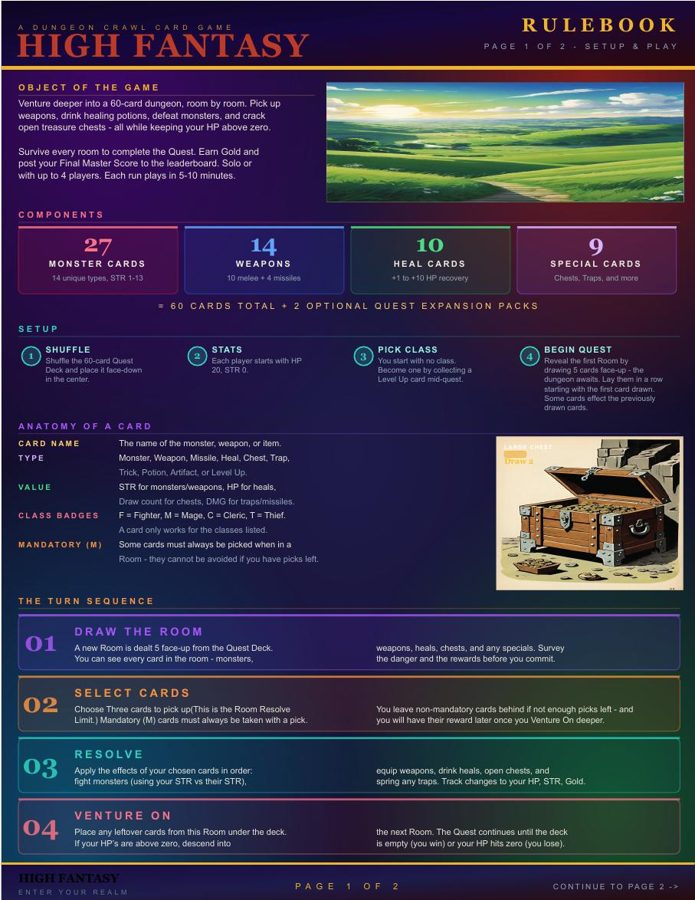
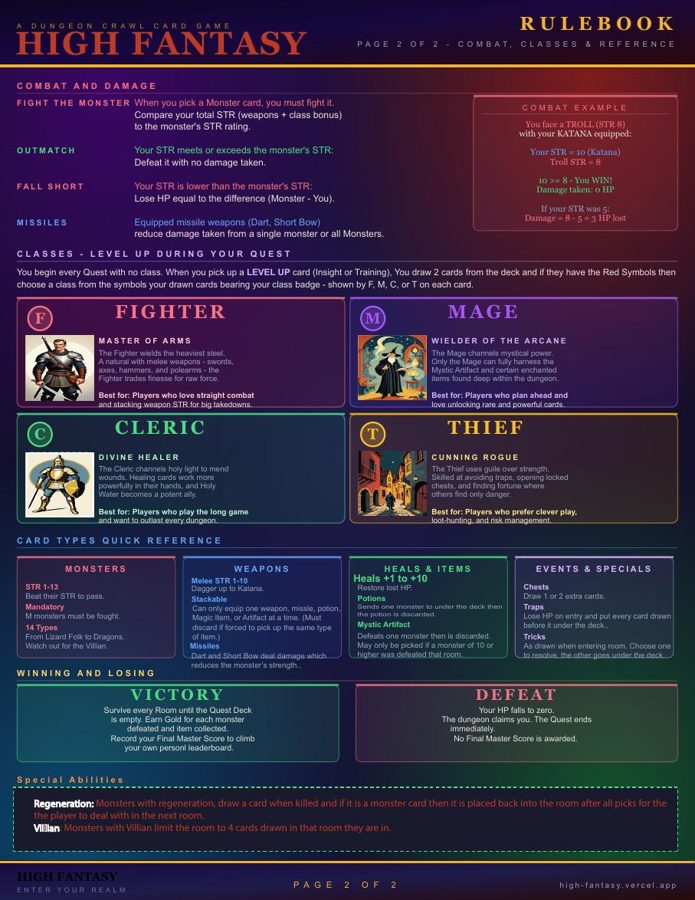
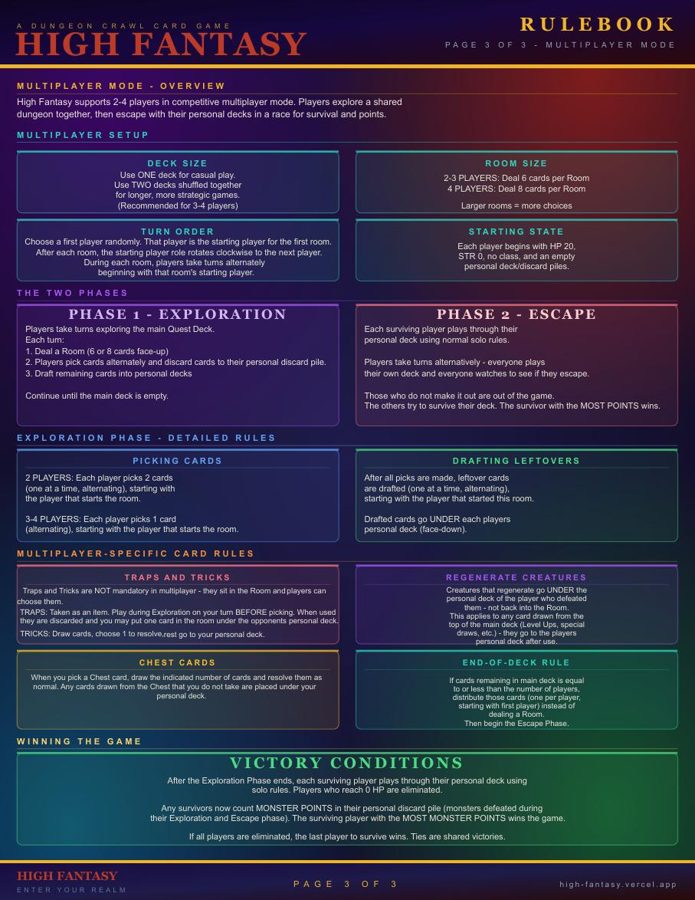
High Fantasy

The Official Rulebook

Three pages: setup & play, combat & classes, and full multiplayer mode. Click any page to open the rulebook, or download the whole thing.